The Stories We Stitch
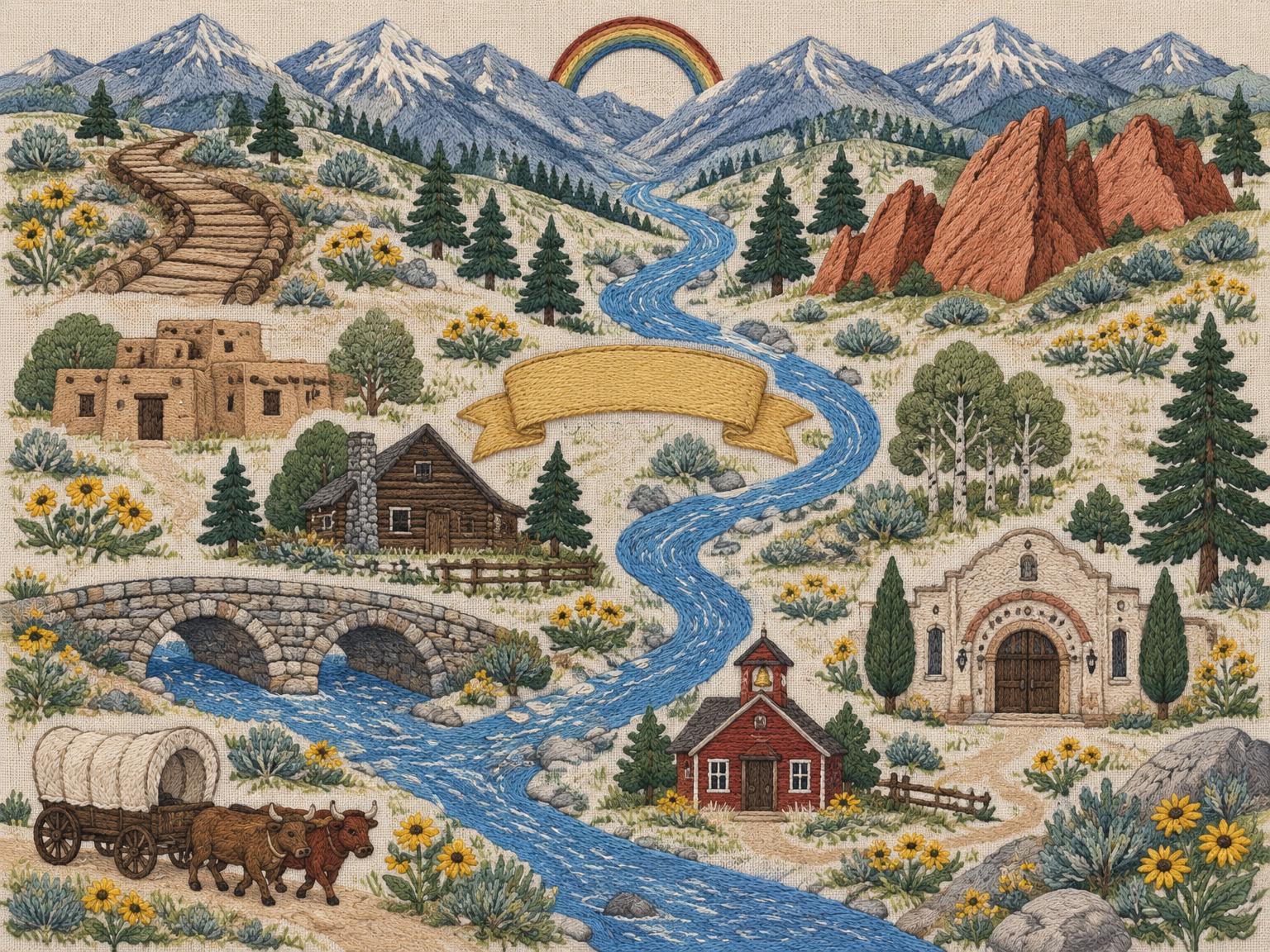
A landscape. Thousands of stitches.
Whose story will pull you in?
Look beyond the mountains and buildings of Women's Gold. Follow three women into questions about home, work and the places we make together.
01 · Chipeta
A landscape is never empty.
What changes when you see these mountains as someone's home?
The official guide places Chipeta against the mountains in the upper left of Women's Gold. Her story brings Ute diplomacy—and forced removal—into a landscape that can otherwise look like scenery.
Look a little closer
Look again at the landscape. What might a portrait tell you that a map leaves out?
The people behind the stitches
One artwork.
More than 3,500 hands.
Unveiled in July 1977 for Colorado's centennial, this nine-by-twelve-foot tapestry took about 4,500 hours over two years. Thousands of people added stitches to a shared portrait of Colorado.
It credits Eva Mackintosh, Carol Carpenter, Geraldine Merrill and Betsey Gottschalk. Nineteen women are named in its brochure—but no single artwork can hold a whole history.
Whose story would you add today?
Meet all 19 women
The brochure's 19 names are a starting point, not a complete history of Colorado women. Identification in the original artwork is separate from what we know about a person's life.
Chipeta
Ute diplomacy, told alongside forced removal.
Located by the official guide
Mother Frances Cabrini
The first naturalized U.S. citizen canonized.
Possible match, still checking
Elizabeth Eyre Pellet
A legislator associated with equal pay and railway preservation.
Located by the official guide
Olga Schaaf Little
Ran a burro train supplying mines.
Possible match, still checking
Clara Brown
Business success and the search for family, in one story.
Possible match, still checking
Captain Ellen Jack
Prospecting and a boardinghouse business.
Possible match, still checking
Antonia Brico
Conducted the New York Philharmonic in 1938.
Not yet found in the tapestry
Doña Genoveva Gallegos de Salazar
A San Luis businesswoman.
Possible match, still checking
Dr. Florence Rena Sabin
Research scientist and advocate for public health reform in Colorado.
Possible match, still checking
Agnes Reid Tammen
Children's hospital philanthropy.
Not yet found in the tapestry
Emily Griffith
Her Opportunity School opened in 1916 for working adult learners.
Possible match, still checking
Mary Coyle Chase
Her play Harvey won the 1945 Pulitzer Prize for drama.
Not yet found in the tapestry
Helen Gilmer Bonfils
Newspaper leadership and arts philanthropy.
Not yet found in the tapestry
Mary Elitch Long
Developed a garden and theater in 1890.
Located by the official guide
Frances Wisebart Jacobs
Advocated for a hospital for poor TB patients. It opened in 1899.
Possible match, still checking
Diana Goldberg
Named as a student of Jacobs. No other biography found yet.
Possible match, still checking
Margaret Crawford
Associated with Steamboat Springs and the Yampa Valley.
Possible match, still checking
Silverheels
A commemorated legend. Her real identity is unknown.
A legend, not a verified history
Patricia Mackintosh
Associated with the future, looking toward 2076.
Possible match, still checking
Follow the other questions
Our questions connect these histories; they are not claims about what the artists intended.
The people behind the stitches
How can thousands of small contributions make one public memory?
The gold that was not metal
What would you carry from a place you had to leave?
The work behind the gold rush
Who supplied, washed, cooked and organized a mining economy?
Many histories on one landscape
What changes when you ask whose home this already was?
Building a place to learn and heal
What does a community need before opportunity becomes real?
Who gets a stage
Who decides what a city hears, sees and imagines?
A name, a legend and a missing record
What can we know when a story is more famous than its evidence?
Who will Colorado remember in 2076?
What would you add to the next public portrait?
Behind the research
This page draws on the Women's Gold research and story map and the official guide referenced there. The three featured women have locations identified by that guide. Our illustration follows scenes in the research, not a curator-verified reproduction.
Many other figure identifications remain tentative. The slat path's possible railway meaning is unconfirmed. Diana Goldberg's biography remains unresolved, and Silverheels is a legend whose real identity is unknown.
A podcast about the people behind the stitches is in development; no episodes have been released.
Meet the original.
Women's Gold hangs on the first floor of the Colorado State Capitol. What will you notice there that an illustration can't show?
Your story belongs in the conversation.
A family connection, a detail we missed, a question that won't leave you alone. We'd love to hear it.
Share a story